- Cataliq Laboratories - "Friday: Off. Factory timing: 11:00 AM – 6:00 PM."
- +91-9265066949
- +91-9327003915
- info@cataliqlabs.com

Oxyclozanide and Levamisole Bolus (FLUDEN-LV)

Third Party Manufacturing Pharma Companies in Gujarat
September 21, 2026
Top 10 Veterinary Medicine Companies in Ahmedabad
September 21, 2026
Oxyclozanide and Levamisole Bolus (FLUDEN-LV): A Guide to Oxyclozanide and Levamisole Bolus (FLUDEN-LV) – Cataliq Labs
Parasitic infections pose a persistent challenge to livestock operations worldwide. Dairy cattle, buffaloes, sheep, and goats continuously encounter internal parasites that compromise their health, growth, and milk yield. While single-ingredient dewormers solve isolated parasite issues, mixed infestations require a broader, more effective treatment strategy.
Combination anthelmintics address this reality directly. Combining two complementary active ingredients into a single dosage form allows livestock managers and veterinarians to treat multi-species parasite loads efficiently. FLUDEN-LV, an Oxyclozanide and Levamisole Bolus, provides a dual-action strategy designed specifically for ruminant health.
In this article, we examine how Oxyclozanide and Levamisole work together, explore their biological mechanisms, outline correct administration practices, and explain why reliable manufacturing standards from companies like Cataliq Labs remain essential for livestock welfare.
The Economic Burden of Parasitic Infections in Ruminants
Internal parasites rarely kill adult ruminants outright. Instead, they cause subclinical damage that quietly undermines farm profitability. Grazing livestock ingest parasite larvae and fluke cysts from pastures, initiating internal infections that drain host resources.
Farmers frequently observe the subtle signs of heavy parasite burdens:
- Declining Milk Production: Dairy cows direct metabolic energy toward fighting infections rather than synthesising milk.
- Weight Loss and Poor Weight Gain: Intestinal damage reduces nutrient absorption, slowing growth rates in calves and lambs.
- Lowered Immunity: Continuous parasite pressure stresses the immune system, making animals vulnerable to secondary bacterial and viral infections.
- Reproductive Inefficiency: Undernourished, parasitized herds exhibit delayed estrus cycles and lower conception rates.
Because pastures often host multiple parasite types simultaneously—such as liver flukes in wet pastures alongside roundworms in dry grazing areas—mixed infections are the norm rather than the exception. Treating these complex parasite loads demands a versatile approach.
Understanding the Dual Actives: Oxyclozanide and Levamisole
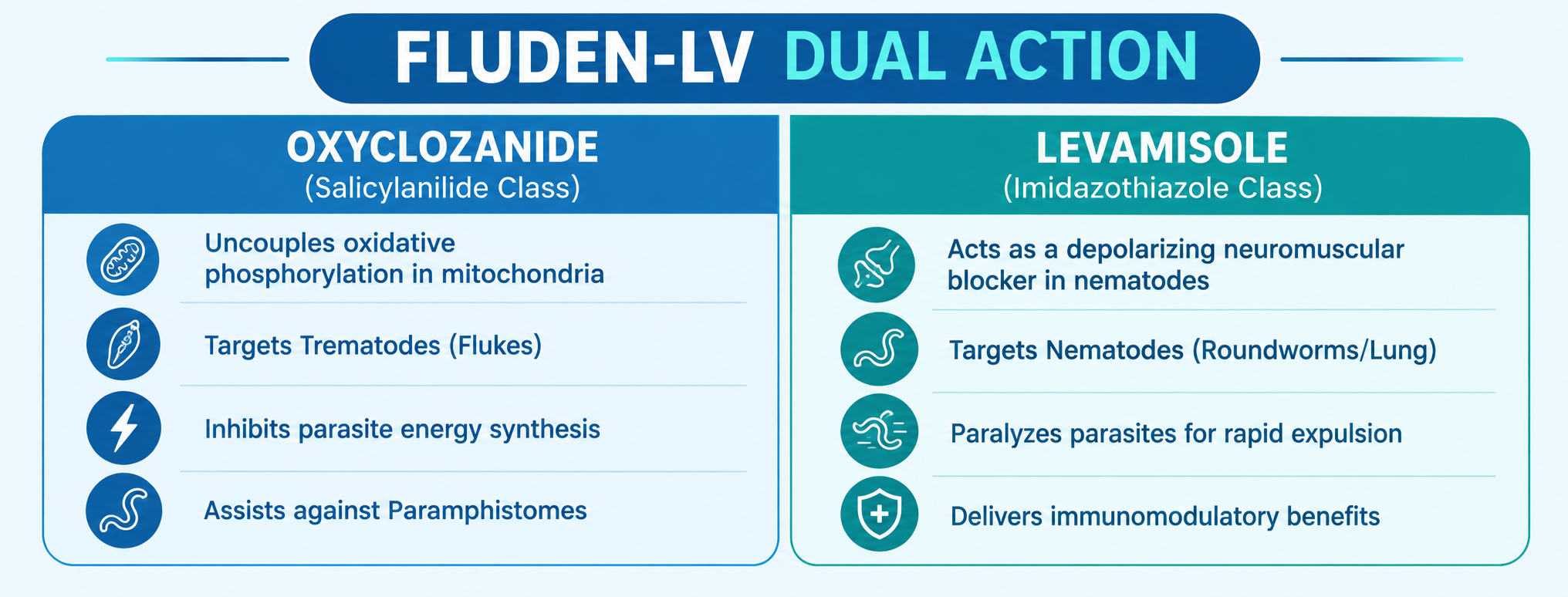
The effectiveness of FLUDEN-LV relies on two proven active pharmaceutical ingredients: Oxyclozanide and Levamisole Hydrochloride. Each ingredient targets a distinct group of internal parasites using different biological pathways.
1. Oxyclozanide: The Flukicide Specialist
Oxyclozanide belongs to the salicylanilide class of anthelmintics. It specifically targets trematodes, commonly known as flukes.
- Mechanism of Action: Oxyclozanide uncouples oxidative phosphorylation within the parasite’s mitochondria. This process disrupts cellular respiration and stops ATP energy production. Starved of essential cellular energy, the parasites die and detach from organ tissues.
- Primary Target Species: It shows exceptional activity against adult Fasciola hepatica and Fasciola gigantica (liver flukes). Furthermore, it aids in controlling Paramphistomum species (rumen flukes) that inhabit the stomach lining of cattle and sheep.
2. Levamisole Hydrochloride: The Nematode Neutralizer
Levamisole belongs to the imidazothiazole class. It functions as a rapid, broad-spectrum agent against roundworms and lungworms.
- Mechanism of Action: Levamisole acts as a depolarizing neuromuscular agonist. It causes continuous stimulation of the parasite’s nerve ganglia, leading to sudden, irreversible muscular paralysis. The host’s intestinal tract then naturally expels the paralyzed worms.
- Immunomodulatory Benefit: Beyond its antiparasitic action, Levamisole restores cellular immune function in stressed or immunosuppressed animals, providing an extra layer of physiological support.
- Primary Target Species: Levamisole eradicates major gastrointestinal nematodes, including Haemonchus, Ostertagia, Cooperia, and Trichostrongylus, as well as lungworms such as Dictyocaulus viviparus.
Strategic Advantages of Combination Dewormers
Choosing a dual-action bolus offers distinct operational and clinical advantages over single-agent treatments.
Broad-Spectrum Coverage in One Pass
Pasture contamination rarely involves a single species. Treating liver flukes with one product and roundworms with another doubles the work, doubles handling stress, and increases operational costs. Combination formulations like FLUDEN-LV tackle both parasitic classes in a single treatment.
Reduced Animal Stress
Gathering and restraining livestock for medication causes physical stress, which can temporarily reduce milk yield or disrupt growth. Administering a single bolus minimizes handling time, keeping herd stress levels as low as possible.
Consistent Dosage Accuracy
Solid oral boluses provide a clear advantage over some liquid drenches by delivering a defined, pre-measured dose. When manufactured under strict quality standards, each bolus delivers an exact ratio of active ingredients directly to the animal.
Target Parasites and Spectrum of Activity
To help livestock managers select appropriate interventions, the following overview details the parasite spectrum covered by this formulation:
| Parasite Category | Specific Organisms Covered | Primary Biological Effect |
| Liver Flukes (Trematodes) | Fasciola hepatica, Fasciola gigantica | Destroys adult flukes in bile ducts, restoring liver functionality. |
| Rumen Flukes | Paramphistomum spp. | Reduces fluke burden in the fore-stomach lining. |
| Gastrointestinal Roundworms | Haemonchus, Ostertagia, Cooperia, Nematodirus | Paralyzes stomach and intestinal worms to clear the digestive tract. |
| Lungworms | Dictyocaulus viviparus | Clears airway nematodes, easing respiratory distress and coughing. |
Administration Guidelines and Best Practices
Achieving optimal therapeutic outcomes requires proper administration technique, correct dosing based on body weight, and strategic timing.
Calculating the Correct Dose
Always base dosage on accurate live weight estimations rather than visual guesswork. Under-dosing fails to clear parasite burdens and accelerates anthelmintic resistance, while over-dosing wastes product and increases toxicity risks.
- Cattle and Buffaloes: Standard field dosing usually targets 1 bolus per 150 kg to 250 kg of body weight, or as directed by a qualified veterinarian.
- Sheep and Goats: Smaller ruminants require precise fractional doses calculated strictly according to body weight (typically 7.5 mg Levamisole and 15 mg Oxyclozanide per kg body weight).
Step-by-Step Administration Technique
- Restrain the Animal: Secure the head comfortably using a headgate or halter to prevent sudden movements.
- Use a Suitable Bolus Gun: Place the bolus into a clean, properly sized veterinary bolus applicator.
- Position Carefully: Insert the applicator over the back of the tongue into the pharynx, taking care to avoid damaging throat tissues.
- Depress the Plunger: Release the bolus smoothly at the back of the throat, triggering the natural swallowing reflex.
- Confirm Swallowing: Hold the mouth closed briefly and observe the neck to ensure the animal swallows the bolus completely.
Strategic Timing for Maximum Impact
Strategic timing amplifies the benefits of deworming protocols.
- Pre-Monsoon Application: Deworming before seasonal rains reduces pasture egg contamination right before parasite activity spikes.
- Post-Monsoon Application: Treating animals after the wet season clears liver fluke populations acquired during peak grazing months.
- Quarantine Treatment: Administering a broad-spectrum dewormer to newly purchased livestock prevents the introduction of resistant parasite strains to your farm pastures.
Safety Considerations and Precautions
While Oxyclozanide and Levamisole present strong safety profiles in ruminants when used correctly, livestock handlers should keep key precautions in mind:
- Species Limitations: Formulate and administer this bolus exclusively for ruminants. Do not give this medication to horses, dogs, cats, or poultry.
- Late-Stage Pregnancy: Handle heavily pregnant cows gently during administration to avoid physical stress or mechanical injury. Always consult a local veterinarian regarding timing during late gestation.
- Water Access: Ensure treated livestock have immediate access to clean, fresh drinking water following deworming.
- Adherence to Withdrawal Periods: Observe meat and milk withdrawal periods strictly according to local regulatory standards to ensure consumer food safety.
The Role of Quality Manufacturing: Cataliq Labs
The therapeutic success of any veterinary drug depends directly on its manufacturing quality. An improperly formulated bolus may dissolve too slowly, break apart prematurely, or contain uneven distributions of active pharmaceutical ingredients (APIs).
Cataliq Labs addresses these challenges through modern pharmaceutical engineering and strict quality management. As an ISO and WHO-GMP certified manufacturer, Cataliq Labs produces veterinary boluses, oral liquids, and powders under rigorous quality control standards.
Key factors that distinguish high-quality manufacturing at Cataliq Labs include:
- Uniform Active Distribution: Precision blending guarantees that every single FLUDEN-LV bolus contains exact, balanced amounts of both Oxyclozanide and Levamisole.
- Optimized Disintegration Rates: Advanced formulation technology ensures the bolus breaks down efficiently inside the rumen, releasing active ingredients rapidly for maximum biological availability.
- Strict API Purity Standards: Cataliq Labs sources pure, high-grade active raw materials, minimizing impurities and maintaining batch-to-batch consistency.
- Protective Packaging Solutions: Moisture-resistant blister packaging guards the structural and chemical integrity of each bolus against humidity and environmental degradation.
By prioritizing regulatory compliance and technical accuracy, Cataliq Labs delivers reliable healthcare products that support livestock productivity and welfare.
Frequently Asked Questions (FAQs)
What makes FLUDEN-LV effective against both flukes and roundworms?
FLUDEN-LV combines two distinct active ingredients. Oxyclozanide disrupts energy production in trematodes (flukes), while Levamisole causes neuromuscular paralysis in nematodes (roundworms and lungworms). This dual formulation targets both parasite classes in a single dose.
Can farmers administer this bolus during pregnancy?
Yes, the active ingredients are generally safe for pregnant ruminants when given at recommended dosages. However, avoid rough handling during late gestation to prevent physical stress, and consult a veterinarian before starting widespread herd treatments.
How frequently should I deworm my herd?
Deworming frequency depends on regional climate, pasture contamination levels, and stocking density. In most tropical and sub-tropical farming zones, deworming twice a year—typically pre-monsoon and post-monsoon—provides effective routine protection.
Does this bolus kill external parasites like ticks or lice?
No. Oxyclozanide and Levamisole act specifically on internal helminths (endoparasites). For external parasites like ticks, lice, or mites, use appropriate ectoparasiticides such as topical pours or sprays.
Why is manufacturer certification important when buying veterinary boluses?
Certifications like WHO-GMP and ISO ensure that the manufacturer follows strict quality controls. Certified facilities, such as Cataliq Labs, verify exact ingredient concentrations, ensure proper dissolution, and maintain freedom from contaminants.
Conclusion
Managing internal parasites is essential for maintaining healthy, productive livestock. Mixed infestations of liver flukes and gastrointestinal nematodes require powerful, well-balanced solutions that minimize labor while maximizing animal recovery.
The Oxyclozanide and Levamisole Bolus (FLUDEN-LV) delivers this comprehensive protection. By understanding parasite life cycles, applying correct dosing practices, and sourcing products from verified WHO-GMP manufacturers like Cataliq Labs, livestock producers can protect herd health, optimize yields, and safeguard farm profitability.
