- Cataliq Laboratories - "Friday: Off. Factory timing: 11:00 AM – 6:00 PM."
- +91-9265066949
- +91-9327003915
- info@cataliqlabs.com

Third Party Veterinary Medicine Manufacturer in Junagadh

Third Party Beta-Lactam Manufacturing in Bhavnagar
August 22, 2026
Third Party Pharma Manufacturing Company in Karnataka
August 24, 2026
The Ultimate Guide to Third-Party Manufacturing: Streamlining Production for Business Growth – Cataliq Labs
In today’s fast-paced commercial environment, businesses must constantly adapt to changing market demands. However, establishing and maintaining in-house production facilities requires enormous capital investments and ongoing operational expenses. Because of this, a growing number of brands are turning to third-party manufacturing to scale their operations efficiently. This strategic model allows organizations to delegate actual production tasks to specialized contract manufacturers. Additionally, it frees up valuable internal resources so companies can focus on strategic marketing and business development. Industry leaders like Cataliq Laboratories showcase how contract manufacturing empowers brands in commercial hubs like Junagarh and across the country to thrive. Ultimately, partnering with an experienced manufacturer can pave the way for sustainable growth and rapid innovation.
What is Third-Party Manufacturing?
Third-party manufacturing, often referred to as contract manufacturing, is a business arrangement where a company hires an external producer to fabricate products under its brand name. For example, a pharmaceutical brand or cosmetics business might design a formula and contract a WHO-GMP certified facility—such as Cataliq Laboratories
—to manufacture, package, and label the finished product. Consequently, businesses in growing industrial regions like Junagarh can launch top-tier pharmaceutical and veterinary lines without spending millions on local machinery.
In contrast to original equipment manufacturing (OEM) where products are made according to standard factory templates, third-party manufacturing allows for extensive customization and strict brand alignment. Furthermore, the client retains full ownership of the brand identity, trademark, and marketing rights. Because of this, contract manufacturers like Cataliq operate purely as production partners behind the scenes, ensuring full operational transparency.
Key Benefits of Third-Party Manufacturing
Outsourcing production offers numerous strategic and financial advantages for startup enterprises as well as established corporations. Below, we examine the most compelling reasons businesses adopt this operational model.
1. Significant Cost Reduction
Building a production plant from scratch demands millions of dollars in infrastructure, machinery, and facility maintenance. Moreover, third-party manufacturing eliminates these massive capital expenditures entirely. As a result, companies in regions like Junagarh can divert their capital toward research, marketing campaigns, and regional expansion.
2. Access to Advanced Expertise and Technology
Specialized manufacturing facilities invest heavily in state-of-the-art machinery and skilled technical personnel. In addition, providers like Cataliq strictly comply with national and international WHO – GMP regulatory standards. For this reason, brand owners gain immediate access to advanced formulation technology and regulatory expertise without incurring training or equipment upgrade costs.
3. Scalability and Operational Flexibility
Market demand can fluctuate unexpectedly throughout the business cycle. However, contract manufacturers possess the infrastructure required to scale production volumes up or down seamlessly. Because of this, businesses can launch small trial batches or mass-produce items without risking inventory shortages or excess surplus.
4. Focus on Core Business Operations
Managing product formulation, equipment maintenance, and factory workforce requires immense operational bandwidth. Meanwhile, delegating these intensive tasks to an external team enables leadership to concentrate on sales, customer support, and strategic partnerships. Most importantly, this division of labor accelerates overall business expansion across competitive markets like Junagarh.
The Step-by-Step Manufacturing Process
To ensure seamless production quality, third-party contract manufacturing follows a structured, multi-stage workflow.
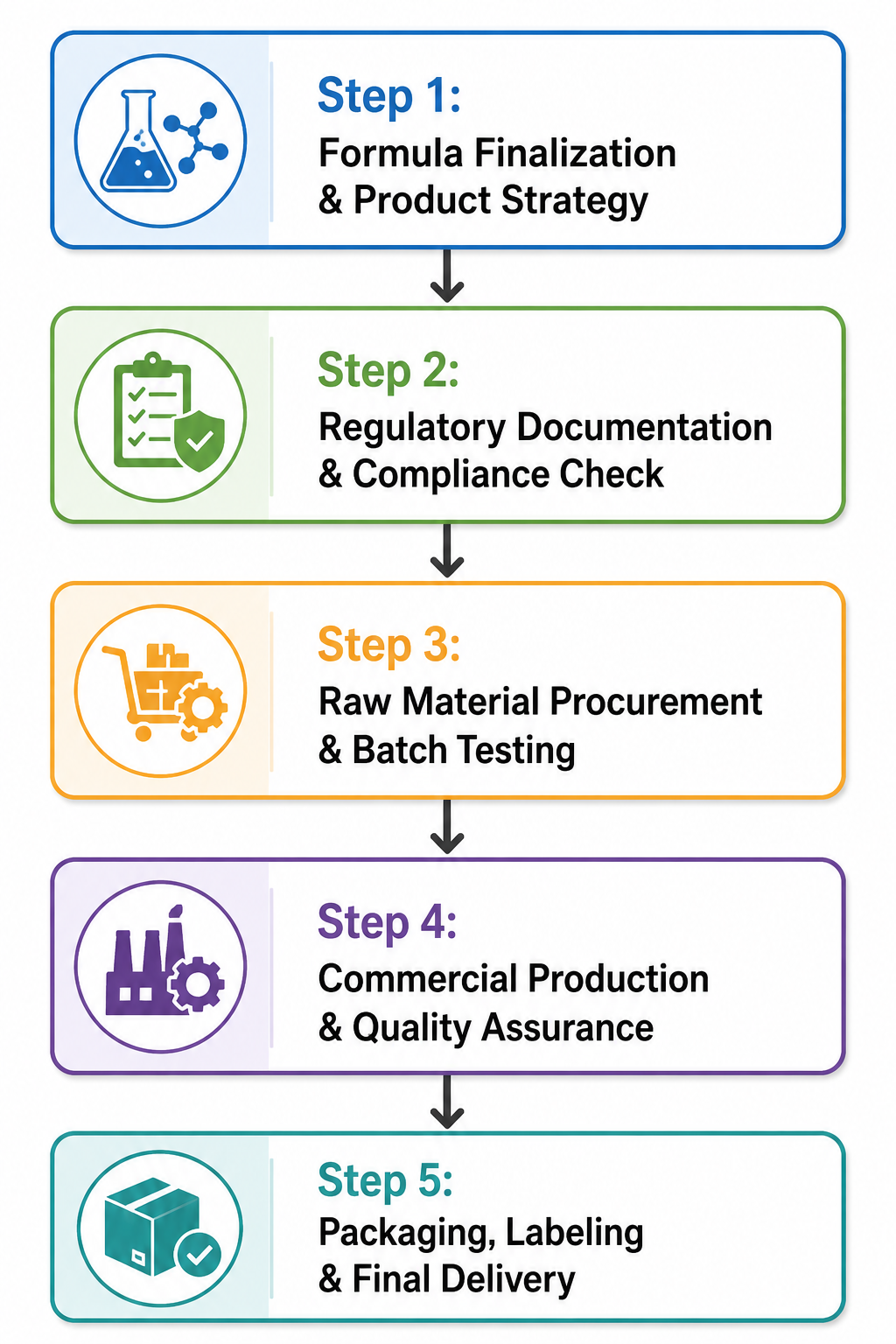
Step 1: Formula Finalization and Quotation
Initially, the client submits their specific product requirements, desired raw materials, and target pricing. Similarly, the manufacturing partner reviews the specifications to determine feasibility and provides a detailed cost estimate.
Step 2: Documentation and Legal Agreement
Before any production begins, both parties finalize non-disclosure agreements (NDAs) and contract terms. In addition, necessary regulatory documentation—such as licensing, safety sheets, and manufacturing permits—is completed. Therefore, complete legal compliance is secured before moving forward with active manufacturing.
Step 3: Raw Material Sourcing and Testing
Once contracts are signed, the manufacturer procures high-grade raw materials and packaging components. At the same time, quality control teams inspect all incoming ingredients to ensure they meet stringent safety parameters.
Step 4: Batch Manufacturing and Quality Assurance
After raw materials pass verification, large-scale commercial manufacturing commences. Furthermore, certified facilities such as Cataliq execute rigorous quality assurance checks at various stages of synthesis to detect any inconsistencies early.
Step 5: Packaging and Delivery
Finally, the finished products are packaged according to custom brand guidelines and labeled for retail distribution. As a result, the finished goods are safely shipped to regional hubs like Junagarh and distribution centers worldwide, ready for commercial sale.
Important Factors to Consider When Selecting a Partner
Finding the right contract manufacturer is critical to protecting your brand reputation and product quality. Therefore, businesses should carefully evaluate several key factors before signing a contract:
- Regulatory Certifications: Ensure the manufacturer holds relevant industry certifications (e.g., ISO, GMP, or WHO approvals). For instance, partners like Cataliq maintain WHO-GMP standards to ensure international quality assurance.
- Production Capacity: Verify that the facility can comfortably handle your current volume demands and future growth projections in key markets such as Junagarh.
- Quality Control Protocols: Inquire about their batch testing procedures and internal quality assurance mechanisms. Likewise, ask about their protocols for handling defective batches.
- Transparent Pricing: Review contract terms to avoid unexpected fees for storage, testing, or customized packaging.
- Communication and Timelines: Most importantly, choose a partner who maintains clear, transparent communication and honors agreed-upon delivery schedules.
Frequently Asked Questions (FAQs)
What is the difference between OEM and Third-Party Manufacturing?
An Original Equipment Manufacturer (OEM) produces products based strictly on the client’s exact design specifications from scratch. On the other hand, third-party manufacturers may offer existing, pre-approved formulations that brands can brand and package as their own, while also offering custom manufacturing options.
How do certified partners like Cataliq support businesses in Junagarh?
Third-party leaders such as Cataliq supply high-quality general and veterinary pharmaceutical formulations directly to distributors and brand owners in Junagarh. Because of this, local businesses in Junagarh can launch reliable, WHO-GMP-certified product lines without building dedicated factories locally.
Who owns the intellectual property (IP) of the product formula?
Ownership depends on the terms stipulated in the legal agreement. For example, if you supply your proprietary formula, you retain total intellectual property rights. However, if the manufacturer provides a proprietary turnkey formula, they may retain ownership while granting you exclusive selling rights under your brand.
How does third-party manufacturing improve business ROI?
Because of this strategic outsourcing, businesses eliminate heavy facility infrastructure costs and reduce headcount expenditure. Consequently, operational overhead drops drastically, leading to higher profit margins and faster return on investment (ROI).
Are minimum order quantities (MOQs) mandatory?
Yes, most contract manufacturers enforce minimum order quantities to cover setup and machinery calibration costs. However, many manufacturers offer flexible MOQs specifically designed for startups and smaller product launches.
Conclusion
Third-party manufacturing has emerged as an indispensable operational model for modern companies looking to scale efficiently. By leveraging external production facilities, businesses can dramatically lower capital expenditures, maintain high product quality, and accelerate time-to-market. Furthermore, established partners like Cataliq Laboratories demonstrate how seamless production support empowers brands in growing industrial zones such as Junagarh.
Ultimately, selecting a reliable, certified, and communicative manufacturing partner is the key to long-term success. Therefore, taking the time to thoroughly vet potential partners will ensure your brand delivers consistent value to its customers while maintaining sustainable profitability.
